HoloModel: two models post-trained from the same 27-billion-parameter base, Qwen3.8-27B, run every agent locally on a single graphics card.
HoloModel-Research
Post-trained by reinforcement learning on verified rewards to write the research code. It scores highest on all five in-house benchmarks, ahead of DeepSeek V4.1 Flash (552B), GLM-5.3 and Kimi K3.1 Pro.
69.1%of Optics-Phy-Bench problems solved
HoloModel-Research 69.1%base model 46.5%
HoloModel-Knowledge
The knowledge model of the system, trained on 39,355 optics publications. It supplies the agents with material data and with evidence linked to its source passages.
39,355optics publications
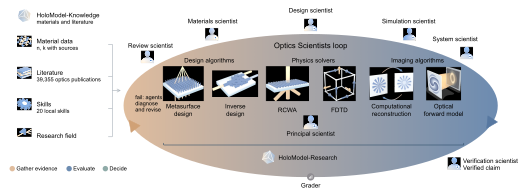
On eight computational-imaging tasks, the agent team solved up to 8 of 8 against 5 for a general-purpose agent framework, using 3.4- to 10-fold fewer tokens.
The harness turns the optics literature into tested ideas and carries the best of them to verified results. In a single 70.5-hour run without human intervention, it went from open problems to article-level results.
6,157open problems
Mine ideas from the literature
The agents distilled open problems from the optics literature and proposed 56,339 ideas for them.
3,102beat their baseline
Screen and verify at scale
A critic kept 15,105 ideas without a fatal flaw; each ran a short sandbox simulation against its own baseline.
14article-level results
Develop in an iterative loop
48 full studies, 32 exceeding tuned baselines, cutting error up to 18.5-fold or computation up to 27-fold.
Open problems from the literature
6,157
Ideas proposed
56,339
Ideas without a fatal flaw
15,105
Beat their baseline in a sandbox
3,102
Full studies
48
Exceed tuned baselines
32
Article-level results
14
What the harness is made of
Agents
Scientist agents
Each role has one responsibility and one source of evidence.
Tools
Design, physics and imaging tools
Design methods, RCWA and FDTD solvers, and imaging reconstruction algorithms.
Memory
Research record
Every candidate is stored with its provenance and every check passed.
Checks
Grader and independent checks
A grader scores candidates; independent checks decide which ones proceed.
Verification
Independent recomputation
Selected results are recomputed at higher fidelity with independent code.
Coordination
Orchestration strategies
Fixed, adaptive and consensus strategies solved up to 8 of 8 tasks.
Skills
Recurring research procedures are written down once as local skills and shared by the whole team. The agents load a skill when a task needs it, so the same procedure is followed the same way every time. The run used 20 local skills.
20local skills
Each skill encodes one recurring procedure, with the steps to follow and the checks that must pass. Every agent follows the same steps instead of rediscovering them, and a fix made to a skill reaches every agent at once.
A skill for every role
Each scientist role has its own skill, from review and design to simulation and verification, and shared skills cover literature search and the research workflow.
Local by design
Skills run alongside HoloModel on the laboratory's own machine, together with the material data and literature the agents draw on. Nothing needs to leave the laboratory, and every procedure can be read, audited and edited by the scientists who own it.
Lean
Theory results are checked by a machine. The proofs compile in Lean 4 with Mathlib, and a build on every change confirms they still hold.
Exceptional-point absorber
15 theorems checked
LeanThe second-order EP attains \(2\sqrt{2/3}\,L\); its 90% band is exactly \(\bigl[-\sqrt{2/3}\,L,\ \sqrt{2/3}\,L\bigr]\)
Lean29.9% of the Bode–Fano ceiling; dimer bound \(2.720\,L\) and its attainment
LeanEnvelope inequality and one-sided reach for canonical EPs
A device whose objective the agents corrected themselves, and a theorem in optical absorption.
Device design
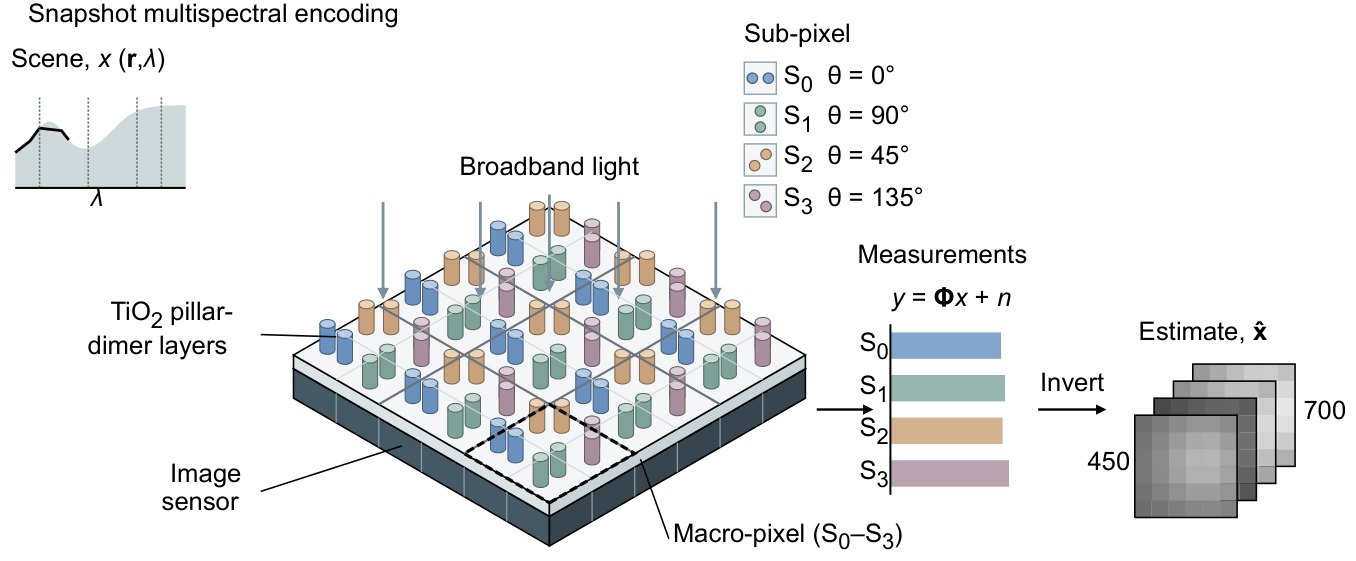
A metasurface encoder for snapshot multispectral imaging
Given only a request to advance research in this area, the agents first pursued high transmission. Their own imaging feedback showed that the bright cells responded almost identically across the spectrum, so the principal scientist replaced the objective with distinct spectral responses at equal incident light.
4.6 dBbetter reconstruction
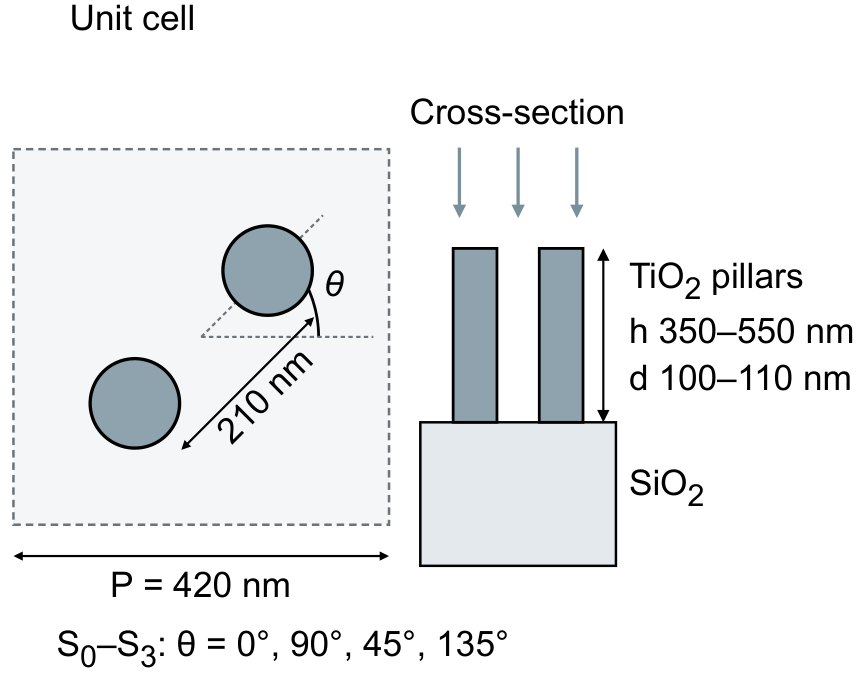
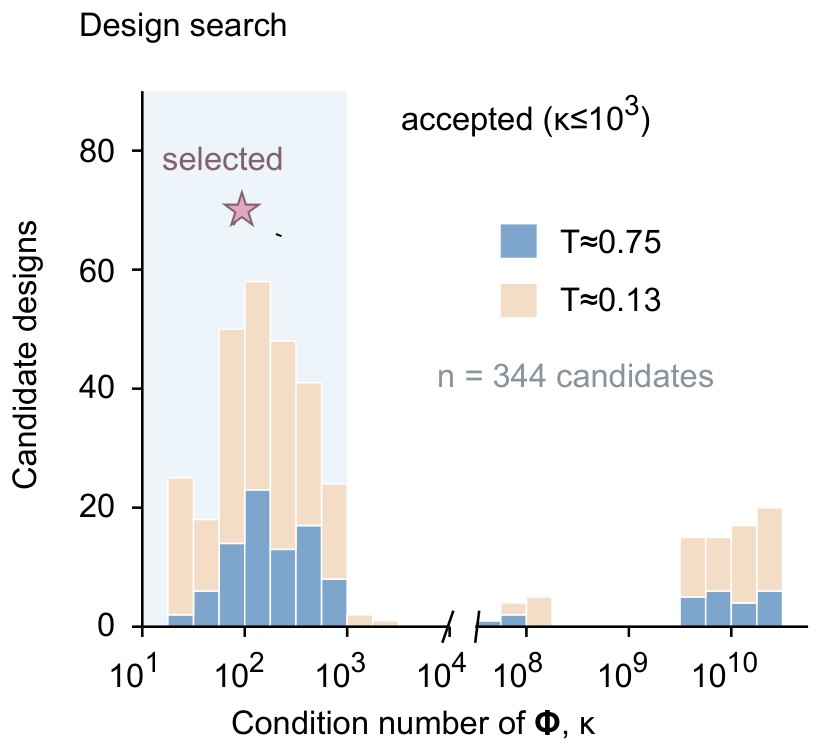
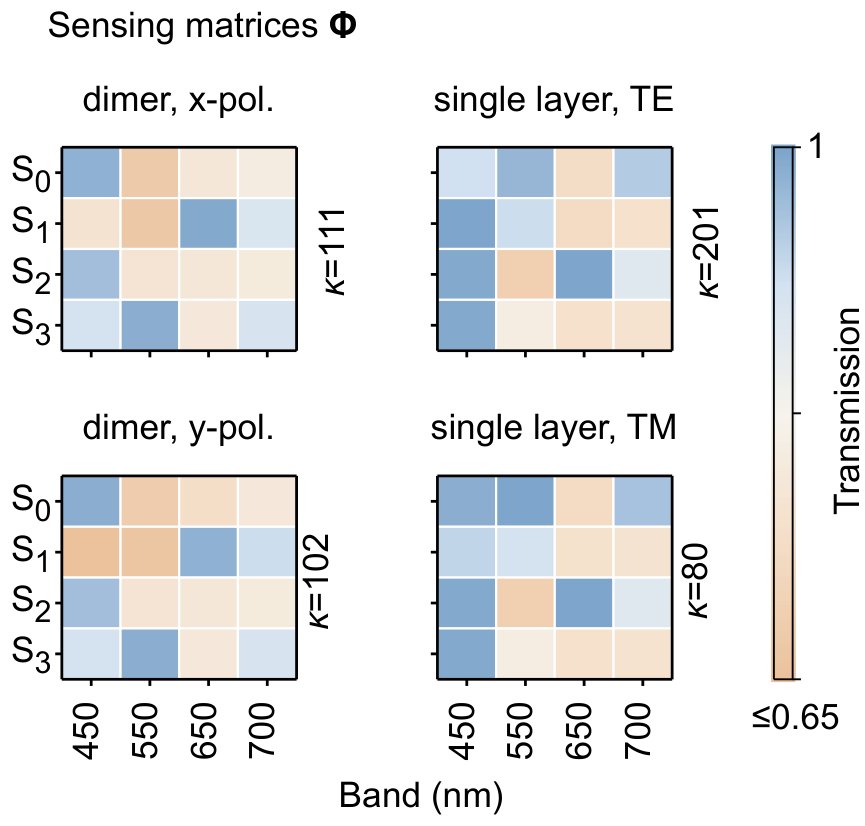
TiO₂ pillar dimers at four orientations halve the condition number of the sensing matrix from 201 to 94; independent verification confirmed the design on eight unseen test scenes.
Unit cell: a TiO₂ pillar dimer rotated by θ.RCWA search over 344 candidate designs.Sensing matrices: dimer versus single layer.
Follow the discovery step by step
Objective: High transmission
Theoretical optics
A bandwidth ceiling for exceptional-point absorbers
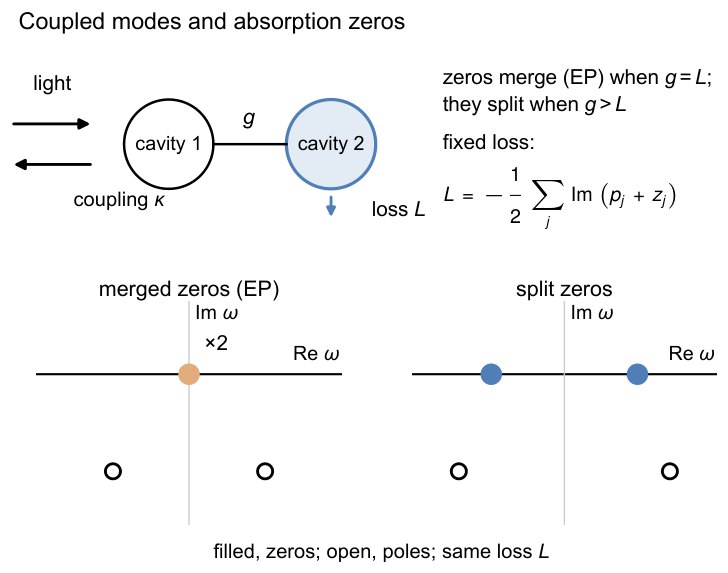
Merging absorption zeros at an exceptional point is widely pursued for broadband absorption. The agents proved that, at equal intrinsic loss L, a perfectly absorbing exceptional point of any order cannot exceed
1.633 L29.9% of the Bode–Fano limit
Splitting the zeros instead reaches 2.720 L with two modes. Part of this result is machine-checked in Lean 4.
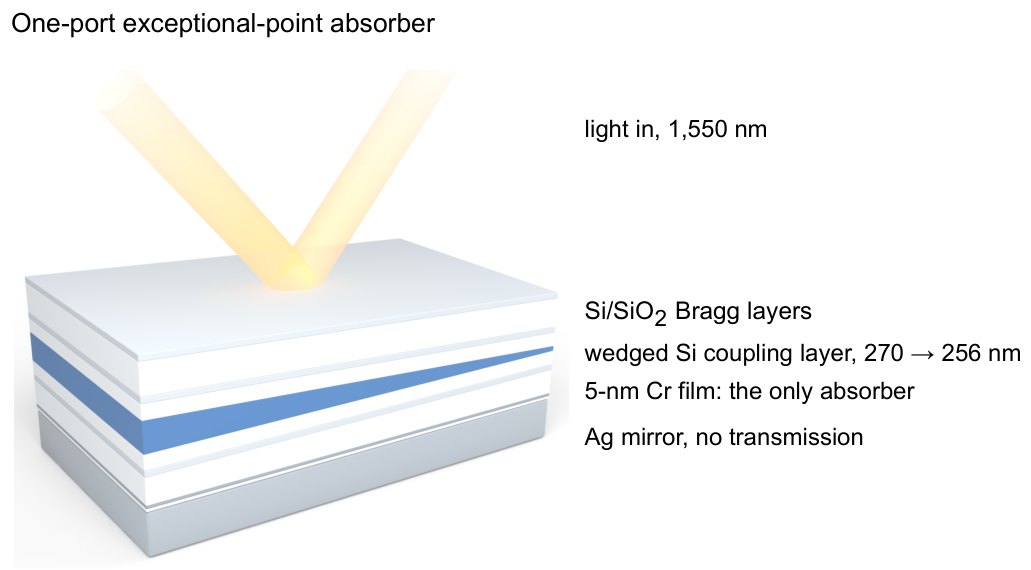
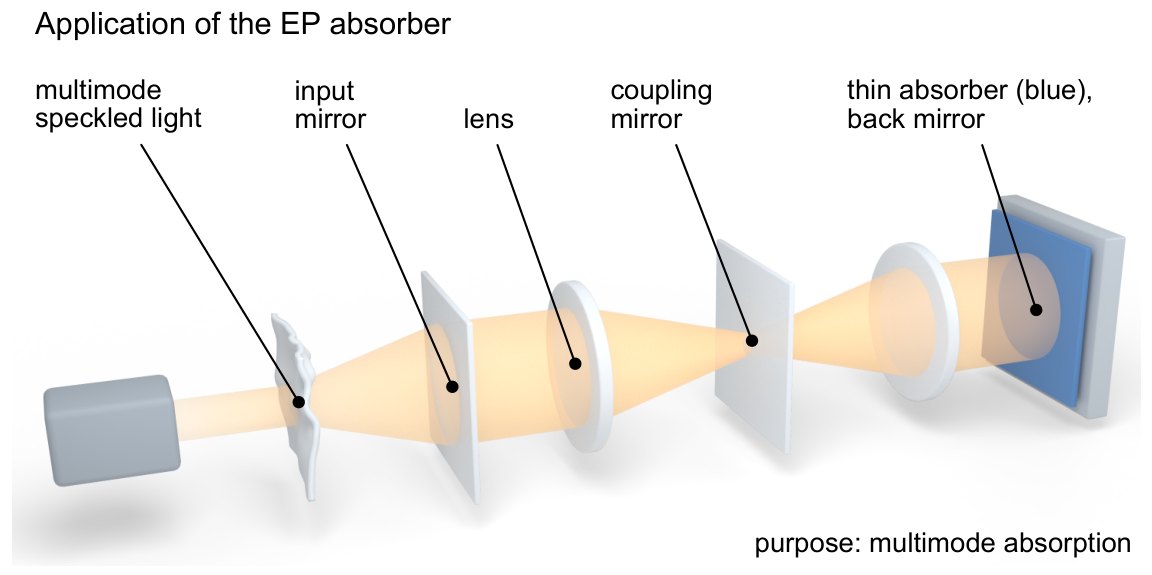
Coupled modes: the zeros merge at the EP (g = L) or split (g > L).Optical path for multimode absorption, after the layout proposed by Hörner et al.
Explore the absorption band: merged versus split zeros
Drag \(g\): the CPA zeros merge at \(g = 1\) and split to \(\pm\sqrt{g^2-1}\) for \(g > 1\).
90% band
EP ceiling\(1.633\,L\)
Best split zeros\(2.720\,L\)
Bode–Fano limit\(5.458\,L\)
The absorption, band edges and the \(2.720\,L\) optimum all follow theorems checked in Lean.
Further auto-research results
Reframing
An assumption the field shares becomes something to design or estimate.
Recombination
Known methods are paired so that one covers the weakness of the other.
Subtraction
Drops a part the standard method assumes.
Gains of the 14 article-level methods
Each method against the strongest tuned standard method it names; bar length on a logarithmic scale.
Four-bit CGHcomputation
27×
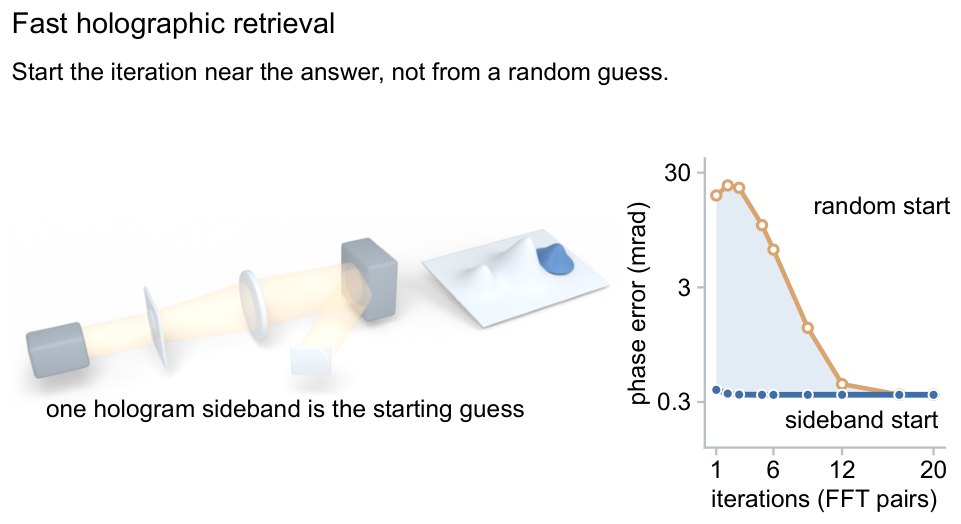
Fast holographic retrievalrun time
27×
Holographic angle sensingtilt error
18.5×
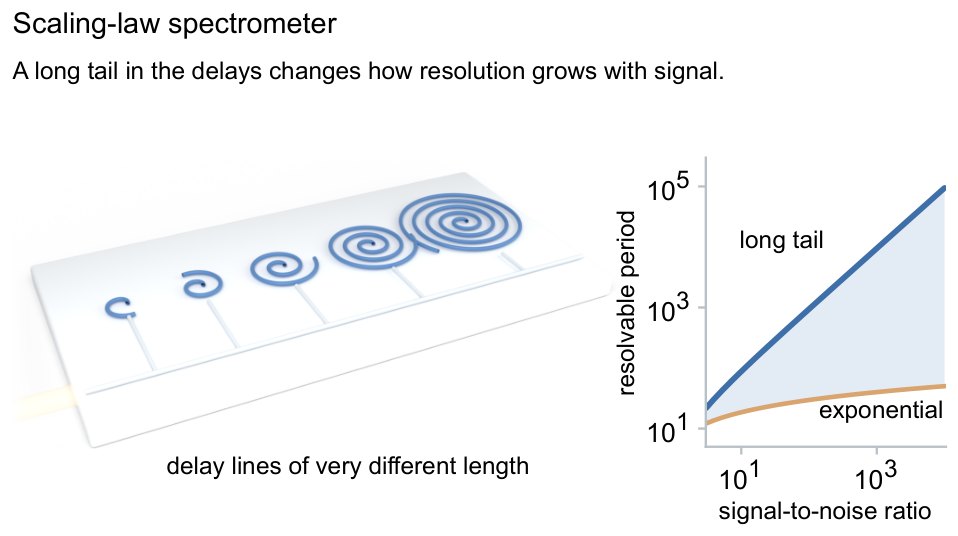
Scaling-law spectrometerresolvable period
14.8×
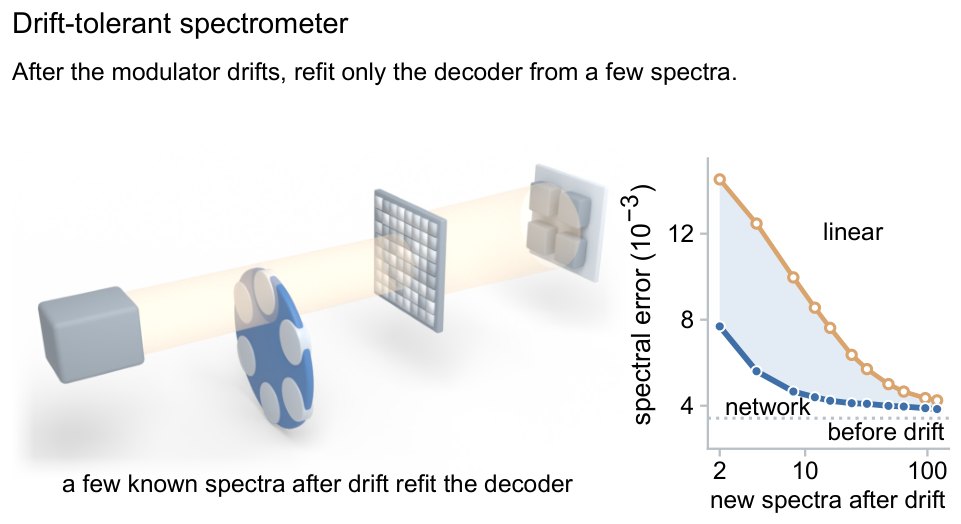
Drift-tolerant spectrometerspectra needed
>6×
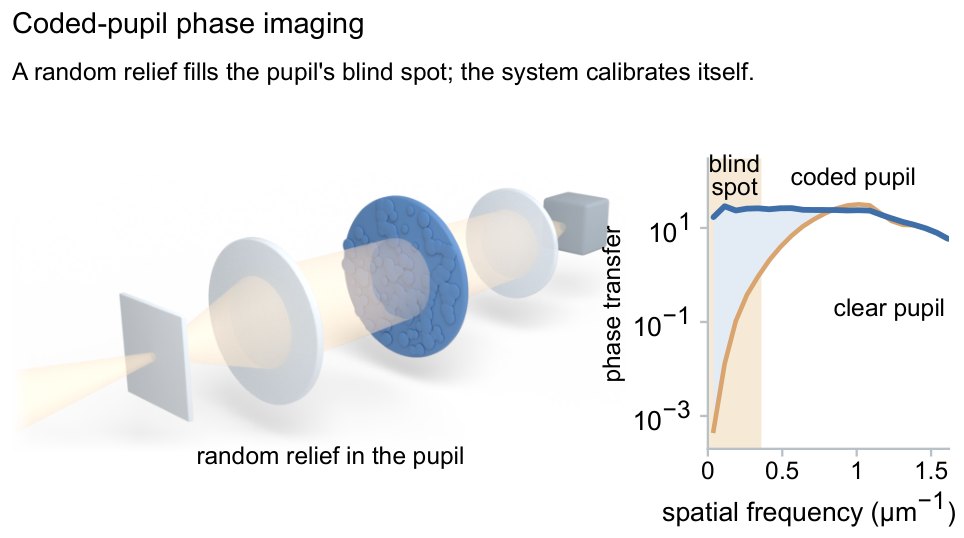
Coded-pupil phase imagingphase error
2.1×
Adaptive Shack–Hartmannwavefront error
2.0×
Metasurface spectral imagerreconstruction error
1.7×
Fibre-array despecklingspeckle contrast
1.7×
EP absorption bound90% absorption band
1.67×
Kramers–Kronig switchingreconstruction error
1.6×
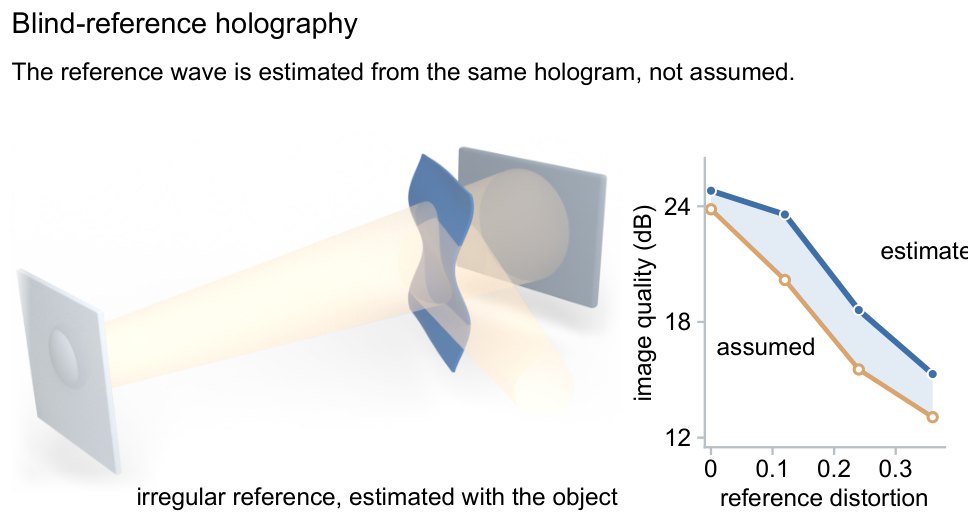
Blind-reference holographyreconstruction error
1.4×
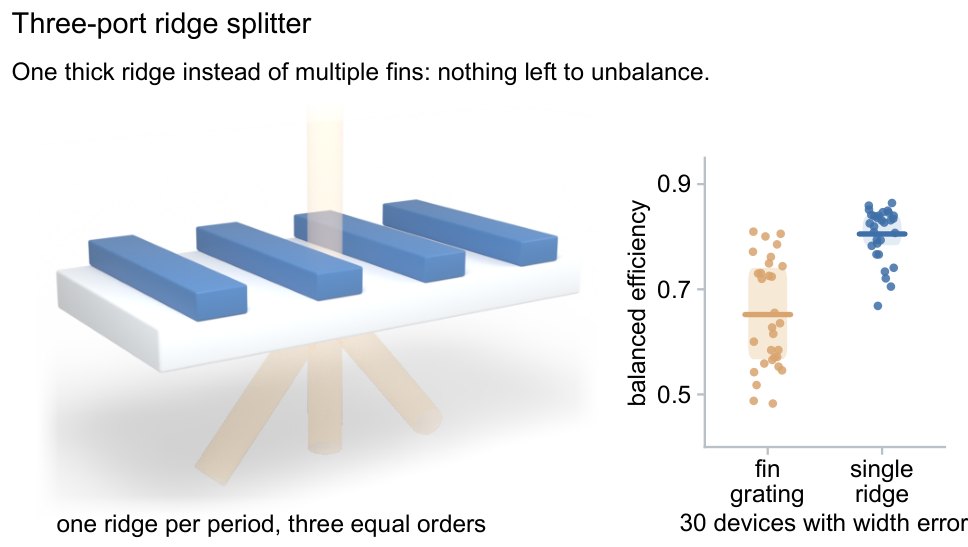
Three-port ridge splitterefficiency
1.2×
Two-port ridge splitterefficiency
1.07×
The agents at work
Each video follows one discovery through the research loop, showing which agent works at each step and what it adds to the research record.
Discovery of the metasurface encoder
The agents correct their own objective and arrive at TiO₂ pillar dimers.
The bandwidth limit of exceptional-point absorbers
From a theory question to a sharp bound and a proposed test structure.